Understanding PCS
What is Pelvic Congestion Syndrome?
Pelvic Congestion Syndrome is a chronic condition caused by varicose veins in the pelvis. It contributes up to 40% of cases of chronic pelvic pain where no other cause is found — yet the average time to diagnosis is up to four years. Prompt, minimally invasive treatment often provides significant relief.
A vascular cause of chronic pelvic pain
Pelvic Congestion Syndrome (PCS) occurs when the veins in the pelvis become incompetent and enlarged, which results in blood pooling in the pelvic veins. This pooling causes pelvic venous hypertension and dilated varicosities around pelvic structures including the uterus, bladder, rectum, and vagina. Distension of these veins can lead to persistent pain and pressure.
The condition most commonly affects women of reproductive age (20–45 years). Pregnancy increases the chances of PCS, however it can present at any age. PCS is increasingly recognised in younger women and may be associated with congenital venous abnormalities or anatomical compression syndromes.
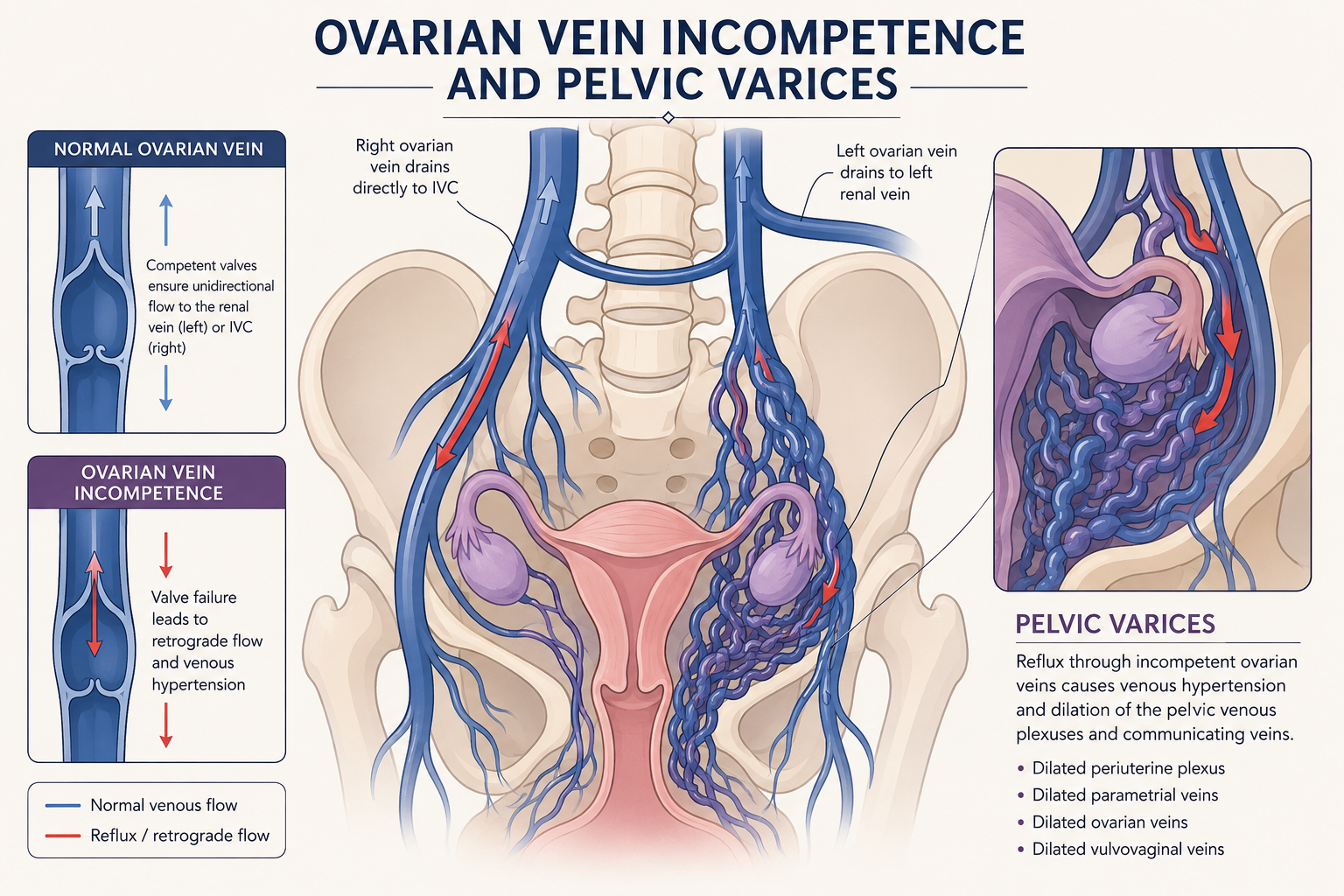
Recognising the symptoms
PCS symptoms are often vague and overlap with other conditions, which is why it is frequently missed. The pain typically feels dull, aching, or heavy, and may be felt on one or both sides of the pelvis. Common symptoms include:
- Chronic dull, aching pelvic pain or heaviness lasting more than six months
- Pain that worsens with prolonged standing, walking, heavy lifting, or at the end of the day — and improves when lying down
- Pain during or after sexual intercourse (dyspareunia)
- Cyclical worsening before and during menstruation
- Visible varicose veins on the vulva, buttocks, thighs, or lower limbs
- Irritable bowel symptoms, bloating, and nausea
- Urinary urgency or frequency
How is PCS diagnosed?
Diagnosis involves a combination of clinical assessment and targeted imaging. Ultrasound with Doppler is the recommended first-line investigation — it is non-invasive, sensitive, and rapid. CT venography or MRI venography may be used to provide a detailed anatomical overview and exclude other pathology. Catheter-directed venography — performed in a catheterisation laboratory — remains the gold standard for confirming the diagnosis and is typically combined with treatment at the same sitting.
Treatment options
Treatment for PCS is tailored to each patient. Not all pelvic congestion requires intervention — the most appropriate approach will be discussed with you at your consultation based on your symptoms, imaging findings, and individual circumstances.
Not every patient with pelvic venous reflux will be a candidate for embolisation. Dr Werner-Gibbings will carefully review your case and advise whether interventional treatment is appropriate, or whether a conservative or alternative approach is recommended. Where there is any concern that another mechanism may be contributing to pelvic pain — such as endometriosis or another gynaecological condition — patients will typically be reviewed by a pelvic pain specialist gynaecologist prior to proceeding with embolisation.
Minimally-Invasive Ovarian Vein Embolisation
For suitable patients, endovascular embolisation is the preferred and gold-standard treatment. Large cohort studies report a technical success rate of 98–100%, with symptom improvement in 80–93% of patients at one to five years of follow-up. A randomised controlled trial demonstrated embolisation to be significantly more effective than both medical therapy and hysterectomy at reducing pelvic pain. The procedure is performed through a small nick in the skin under local anaesthetic, requires no open surgery, and allows most patients to return to normal activities within 48 hours.
Ovarian vein embolisation
A catheter is guided through a small nick in the skin to the affected ovarian vein. Platinum coils are used to block the abnormal vein, redirecting blood flow and relieving pressure. The procedure is performed as a day procedure under local anaesthetic, with most patients returning to their normal routine within 48 hours.
Pelvic vein embolisation
Where additional pelvic varicosities are contributing to symptoms, these can be treated at the same time. Onyx — a widely used liquid embolic — may be used to seal off the pelvic veins to improve outcomes and reduce the risk of recurrence.
Diagnostic imaging & consultation
For patients who are unsure of their diagnosis, Dr Werner-Gibbings offers specialist consultation and imaging review to determine whether PCS is the cause of their symptoms and to plan the most appropriate treatment.
Conservative management
For patients with mild symptoms, or where embolisation is not yet indicated, conservative measures may be trialled first. Hormonal therapies — including medroxyprogesterone acetate (MPA) and gonadotropin-releasing hormone (GnRH) agonists — can suppress ovarian function and reduce pelvic blood flow, however the effects are often short-lived and they are not efficacious in the long term. Venoactive drugs (such as micronised purified flavonoid fraction) may help reduce venous distension and discomfort. Compression therapy (compression stockings) and pelvic floor physiotherapy may also provide symptomatic relief. While these approaches can help manage symptoms, they do not address the underlying venous reflux and are generally less effective for moderate-to-severe PCS.
Open and laparoscopic surgical options
Surgical management — including laparoscopic ovarian vein ligation or, in selected cases, hysterectomy with salpingo-oophorectomy — has historically been used for PCS. These procedures carry greater operative risk, longer recovery times, and more significant implications than endovascular treatment. Laparoscopic ligation is also performed with the patient supine and the abdomen insufflated, which may underestimate the number of varices and reduce procedural efficacy. Surgical options are generally reserved for patients in whom embolisation has failed or is not technically feasible. Embolisation remains the preferred option for the vast majority of patients.
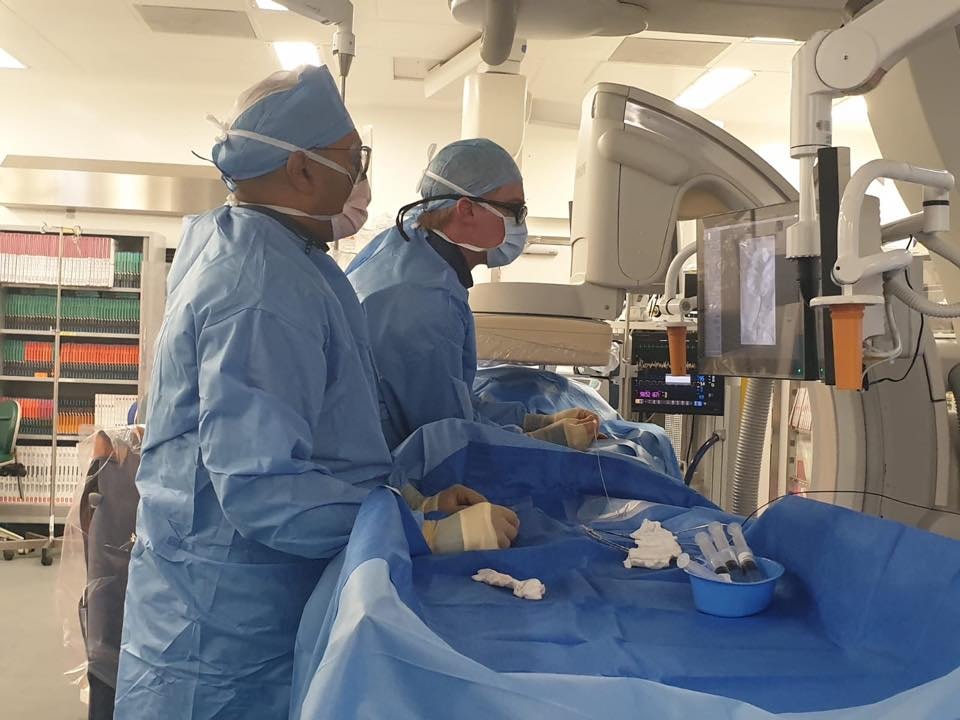
Minimally invasive pelvic vein embolisation — performed under image guidance in a dedicated interventional suite
Think you may have PCS?
If you have been experiencing chronic pelvic pain and suspect PCS may be the cause, our specialist surgeons can help. A referral from your GP or specialist is required.